Teaching a model about drape and weight
Two garments cut from the same pattern can hang completely differently. The difference is in the cloth, and the cloth is what photographs record worst.
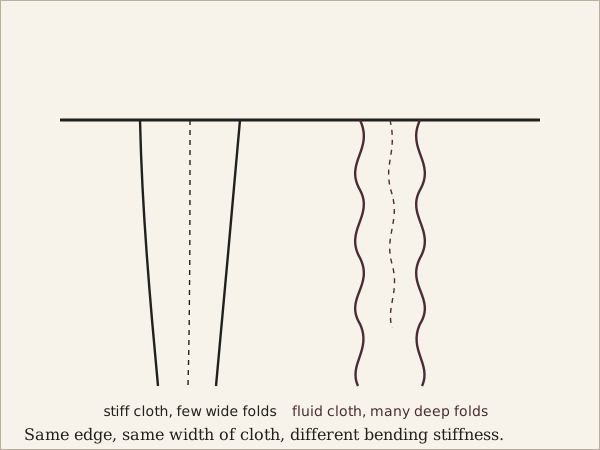
Give the same pattern to two makers and let one use a stiff cotton and the other a soft viscose, and the results will not look like the same garment. One will hold the shape the pattern drew; the other will fall, cling and gather. Nothing about the pattern changed. What changed is a set of mechanical properties of the material, and those properties are the part of clothing that image-based systems capture least well.
The properties that matter
Textile engineering has measured cloth behaviour for a long time, and the vocabulary is well established.
- Weight, the mass per unit area. The most commonly published figure and the crudest, though it correlates with a great deal.
- Bending stiffness, the resistance to being curved. This is the property that decides whether a cloth forms few large folds or many small ones.
- Shear, the resistance to being deformed diagonally. Shear behaviour is why a garment cut on the bias moves differently from one cut on the grain.
- Drape, usually expressed as a coefficient from a standard test in which a circular sample is supported at its centre and the area of its shadow is compared with the area of the flat disc. A stiff cloth casts a wide shadow, a fluid one a narrow, deeply folded shape.
- Surface friction and thickness, which govern how layers slide over one another and how a seam sits.
These are measured with laboratory instruments on physical samples. They are not, in any direct sense, visible in a photograph.
The inference problem
What a photograph does contain is the consequence of those properties: the number and depth of folds, how sharply the cloth turns at an edge, how it breaks over a shoulder or across a lap. A model can learn to associate those appearances with material categories, and this works to a degree. Fold structure is genuinely informative, and a system can often distinguish a heavy woven from a light knit reliably.
The inference is confounded, though, and by more or less everything. The same cloth photographs differently depending on how the garment was arranged before the shutter opened, whether it was steamed, how it was hung, how it was lit, and what it was previously folded into. A crease from packaging reads as a fold. A studio arrangement smooths away exactly the fall the system is trying to observe. And the most useful evidence, how the cloth moves, is absent from a still image entirely.
The most useful evidence, how the cloth moves, is absent from a still image entirely.
The label is better than the picture
There is a strong practical argument for using the information that already exists rather than inferring it. A garment has a composition, a construction and usually a stated weight. A cloth described as a heavy woven cotton twill is telling the system more about its bending behaviour than a photograph of it will, and it is doing so as a categorical fact rather than an estimate.
This is unglamorous. It is a lookup rather than a model. It is also more reliable, and it degrades gracefully: when the composition is missing, the system knows it is missing, which is exactly what an inference from an image never tells you.
Why it matters for fit
Fabric behaviour is not a cosmetic concern that can be deferred. It determines how much of the ease drafted into a garment is actually available to the wearer. A stiff cloth holds its drafted dimensions, so the ease is real room. A cloth with give absorbs some of that dimension by stretching, and a very fluid one gives up shape entirely and follows the body underneath.
Two garments with identical measurements on the tape can therefore fit differently in a way no comparison of numbers will predict. A fit system that reasons only about dimensions is reasoning about the pattern rather than the garment, and the wearer experiences the garment.