This week’s editionA weekly paper on machine learning and what we wear

FitCheckLab

The weekly paper of clothing, fit and machine learning

News

Why fit prediction still stalls at the shoulder
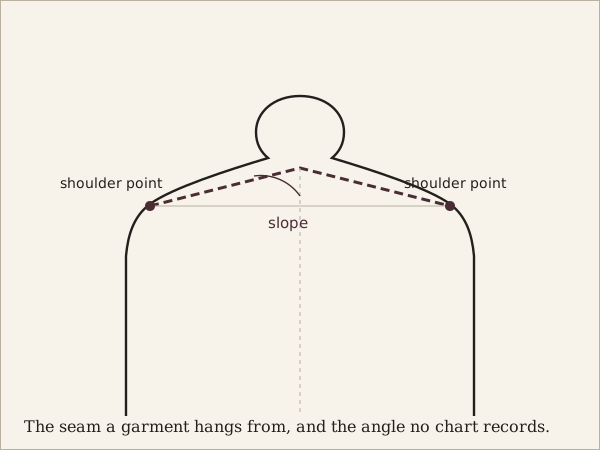
Line figure of a shoulder seam sitting across a body outline, with the slope angle marked.

The shoulder is the joint a garment hangs from, and it is the measurement clothing systems record least well. Everything downstream of it inherits the error.

Ask a tailor where a jacket is decided and the answer is the shoulder. The chest can be let out, the waist can be taken in, the sleeve can be shortened and the hem can be raised. The shoulder is the one line that cannot be moved far without rebuilding the garment around it, because it is the seam the whole weight of the cloth hangs from. Get it wrong and the error does not stay local: the sleeve twists, the collar stands away from the neck, and a drag line runs diagonally across the back that no amount of adjustment elsewhere will remove.

This is precisely the measurement that automated fit systems handle worst, and the reason is not a shortage of computing power. It is that the shoulder is hard to define, hard to see, and hard to write down in the format the rest of the pipeline expects.
Also this week

Models

How garment segmentation actually works

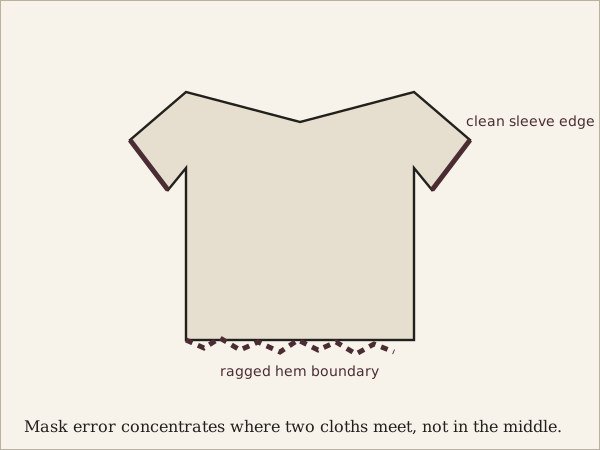
Diagram of a garment segmentation mask, with a clean sleeve boundary and a ragged hem boundary marked.

Separating a garment from everything else in a photograph sounds like a solved problem.

Sizing

The long history of the size chart

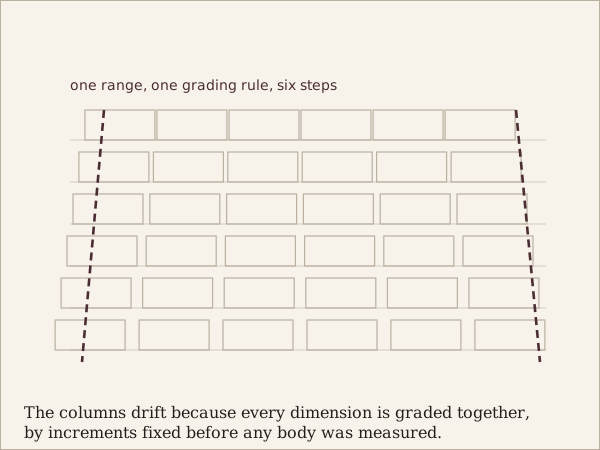
A size-chart grid whose column boundaries drift out of alignment from one row to the next.

Every automated sizing system inherits a set of numbers that were assembled long before anyone thought to compute with them.

From the journal

01Dental-X AI Delivers Revenue Cycle Automation for US Dental Practices02Why Is Charlotte IT Solutions the Best for Managed IT Services Provider?03Who's the Best for Application Development: Biz Technology Solutions vs Charlotte IT Solutions04Elite High Performance Coaching vs Eli Bowman for Peak Performance Coaching05The Mistakes Ecommerce Stores Make With Order Updates

Bulletin

Sizing

Ease

The deliberate room drafted into a garment over the body measurement, so the wearer can move, breathe and get dressed. It is a design decision and is rarely published in a chart.

Sizing

Grading

Expanding or contracting a base pattern by fixed increments to produce a range of sizes. Every dimension moves together, which is why unusual proportions fall between sizes.

Sizing

Bust and chest

Two different measurements taken at two different points and frequently treated as one column. A chart that does not say which it holds cannot be safely compared with another.

Fabric

Drape coefficient

A figure from a standard test in which a circular sample is supported at its centre; the ratio of the shadow area to the flat disc area describes how fluidly a cloth falls.

Fabric

Bias

A garment cut at forty-five degrees to the weave, which allows the cloth to shear and follow the body. Bias-cut pieces behave quite unlike the same pattern cut on the grain.

Fabric

Metamerism

Two cloths that match under one light source and visibly differ under another, because their reflectance spectra differ while integrating to the same response.

What the numbers report

Seven measurement tasks, the figure usually published for each, and the failure that figure conceals
Measurement taskQuantity usually reportedWhat that quantity hides
Garment segmentationOverlap of predicted and true mask areaBoundary error, which is where every downstream measurement is taken
Body dimension estimateMean error across all dimensionsWhich single dimension is weak, and the shoulder usually is
Pose estimationKeypoint distance, averaged over jointsWhether the landmark was visible at all under the garment
Virtual try-onPerceptual similarity to a real photographWhether the garment being rendered would actually close
Fit classificationOverall accuracy across three outcomesThat predicting too small and too large are different failures
Size recommendationRate of garments sent backReturns avoided by friction rather than by a better match
Colour reproductionDifference from the reference imageAppearance under any illumination other than the one used

From the desk

Opinion

The mirror is not a measurement

A fit score is a compression of a garment, a body and a judgement into one number. It is worth asking what falls out in the compression.

A note on averages

Nearly every metric in this field is a mean over parts of a problem that are not interchangeable. The mean of a shoulder and a hem is not a garment, and the mean of a too-small and a too-large error is not a mistake anyone makes.

A note on ground truth

Most fit labels are derived from whether an item came back and what box was ticked on the way. That is a proxy, and it is worth saying so before the number is used to settle an argument.