Colour under a camera, and why it lies
The colour of a garment in a photograph is a joint statement about the cloth, the light and the sensor. Only one of those three is for sale.
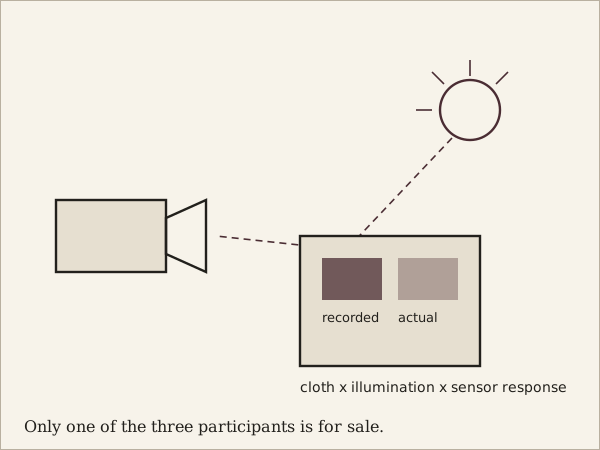
Colour is among the most common reasons a garment disappoints on arrival, and it is often filed alongside sizing problems as though it were a similar sort of failure. It is not. Size error is usually a matter of measurement. Colour error is a matter of physics, and the physics guarantees that no single photograph can be a complete description of what a cloth looks like.
Three things multiplied together
What a camera records at a pixel is, in essence, the light that arrived there. That light is the illumination falling on the cloth multiplied by how the cloth reflects each wavelength, integrated through the sensor's own colour response. Change the illumination and the recorded value changes even though nothing about the garment has.
This is why a fabric can look one colour in a shop under fluorescent light and another in daylight at the door. It is not an illusion and it is not a printing error. The cloth is reflecting different incident spectra, and the eye, which does a remarkable amount of automatic compensation, still cannot fully undo it. The camera compensates too, through white balance, and its compensation is an estimate that can be wrong.
Where the pipeline adds its own drift
Between the cloth and the screen sit a number of further transformations, each reasonable and each lossy.
- White balance estimates the illumination from the scene. A large area of strongly coloured cloth can bias that estimate, so a vividly coloured garment can shift its own recorded colour.
- Colour space conversion maps sensor values into a standard space. Saturated colours can fall outside that space and get clipped towards the boundary.
- Compression discards colour detail preferentially, because human vision is less sensitive to fine colour variation than to fine brightness variation.
- Editing for consistency, which is normal practice, adjusts images so a range looks coherent. It is a deliberate change to recorded colour.
- The viewer's own display then applies its own profile, brightness and ambient conditions, none of which the pipeline can see.
Each transformation is reasonable on its own, and the chain is lossy end to end.
The failure no camera can record
There is a further effect worth naming because it defeats the whole approach. Two cloths dyed to look identical under one light source can look plainly different under another. This happens when their reflectance spectra differ but happen to integrate to the same response under that particular illumination. Under a different spectrum the match breaks.
For a buyer this is the experience of two garments matching in the shop and clashing in daylight. For a system it is a hard limit: an image taken under one illumination cannot predict the appearance under a different one, because the information that would be needed, the full spectral reflectance, was collapsed into three numbers before the file was written.
What helps
Consistency is worth more than accuracy here. A range photographed under one controlled lighting setup, with a fixed white balance and a colour reference in the frame, will at least be internally comparable, so a buyer who has learned how one garment turned out can predict the next. Publishing the colour name and the dye or yarn description alongside the image gives a second, non-photographic channel. And describing the light the photograph was taken under, plainly, tells the viewer what they are looking at.
What does not help is treating the recorded pixel value as the colour of the cloth. It is a measurement of a particular meeting between cloth, light and sensor, and the cloth is only one of the three participants.