Body measurement datasets and their gaps
The reference populations behind body models were assembled for particular purposes by particular institutions. Those purposes are still visible in the results.
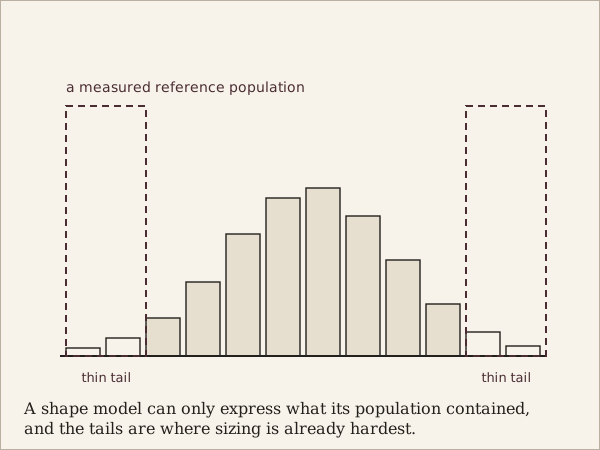
Any system that turns an image into body dimensions is standing on a population of measured bodies. The parametric shape models used in clothing work are learned from scanned or measured people, and the range of shapes such a model can express is the range that population contained. It follows that the composition of that population is not a technical footnote; it is a property of the model that no amount of downstream engineering removes.
Why populations get measured
Large-scale anthropometric surveys are expensive and are therefore usually commissioned for a reason. Historically the reasons have included military uniform and equipment sizing, workplace and vehicle ergonomics, protective equipment design, and the garment industry's own periodic attempts to re-base its grading. Each purpose shapes the survey.
- A survey conducted for uniform sizing samples the population that wears the uniform, which is selected by age and by fitness requirements before any measuring begins.
- A survey conducted for workstation ergonomics records the dimensions relevant to reach and posture, and may not record the girths a garment needs.
- A survey conducted in one country describes that country's population at that time, and body dimensions differ across populations and shift across decades.
- A survey conducted decades ago remains in use long after the population it described has changed, because repeating it is costly.
How the gap shows up
A shape model fitted to a body outside its training range does not announce a problem. It produces the closest shape it can express, which means it pulls unusual proportions towards the typical ones it has seen. The output looks like a body, the numbers look like measurements, and the error is largest for exactly the people least well served by standard sizing in the first place.
The error is largest for exactly the people least well served by standard sizing in the first place.
This compounding is the part worth dwelling on. Someone whose proportions sit outside the grading assumptions already finds ready-to-wear difficult. An automated system trained on a population that under-represents those proportions will estimate their measurements least accurately, and will then compare those estimates against a size range that was not drafted for them. Two independent sources of error pointing the same way.
What can be done without a new survey
Commissioning fresh anthropometric data is beyond most projects, but several things are not.
- State the reference population. If a shape model is built on a particular survey, that fact belongs in the documentation, along with when and where it was collected.
- Report per-measurement error rather than an average. A single accuracy figure hides which dimensions the model is weak on, and the weak ones are usually the informative ones.
- Evaluate on the tails deliberately. A stratified evaluation that reports performance separately for bodies far from the population mean will reveal a collapse that an overall average conceals.
- Prefer measured input where it is available. A person who has measured their own chest with a tape has supplied better data than any estimate from a photograph, and a pipeline should treat that as authoritative rather than as one more feature.
- Return an interval, not a point. An estimate that carries its own uncertainty lets a recommendation be appropriately hedged instead of falsely precise.
The honest position
Estimating body dimensions from an ordinary photograph is a genuinely hard inverse problem: a two-dimensional projection of a three-dimensional shape, partly occluded by cloth, at an unrecorded distance with an unrecorded lens. That it works at all is an achievement. That it works less well for bodies the reference population under-sampled is not a defect that better architecture will fix, because the limitation lives in the data rather than in the model.
Saying so plainly is not pessimism. It is the difference between a tool whose limits are documented and a tool whose limits are discovered by the person it fails.