Is Autoblogging.ai Good for Long-Form SEO Articles? An Honest Review
Long-form SEO articles take hours to write, and AI drafts often collapse after 1,500 words. If you publish 20 posts a month, that gap costs you rankings and editing time. Autoblogging.ai claims its Godlike Mode closes it.
This review answers whether Autoblogging.ai handles long-form SEO articles, how Godlike Mode builds depth through SERP analysis, LSI keywords, and knowledge graphs, and where a human editor is still required. You will also see its pricing, bulk and WordPress features, and a clear verdict on who should use it.
What Is Autoblogging.ai? The Entity Behind the Review
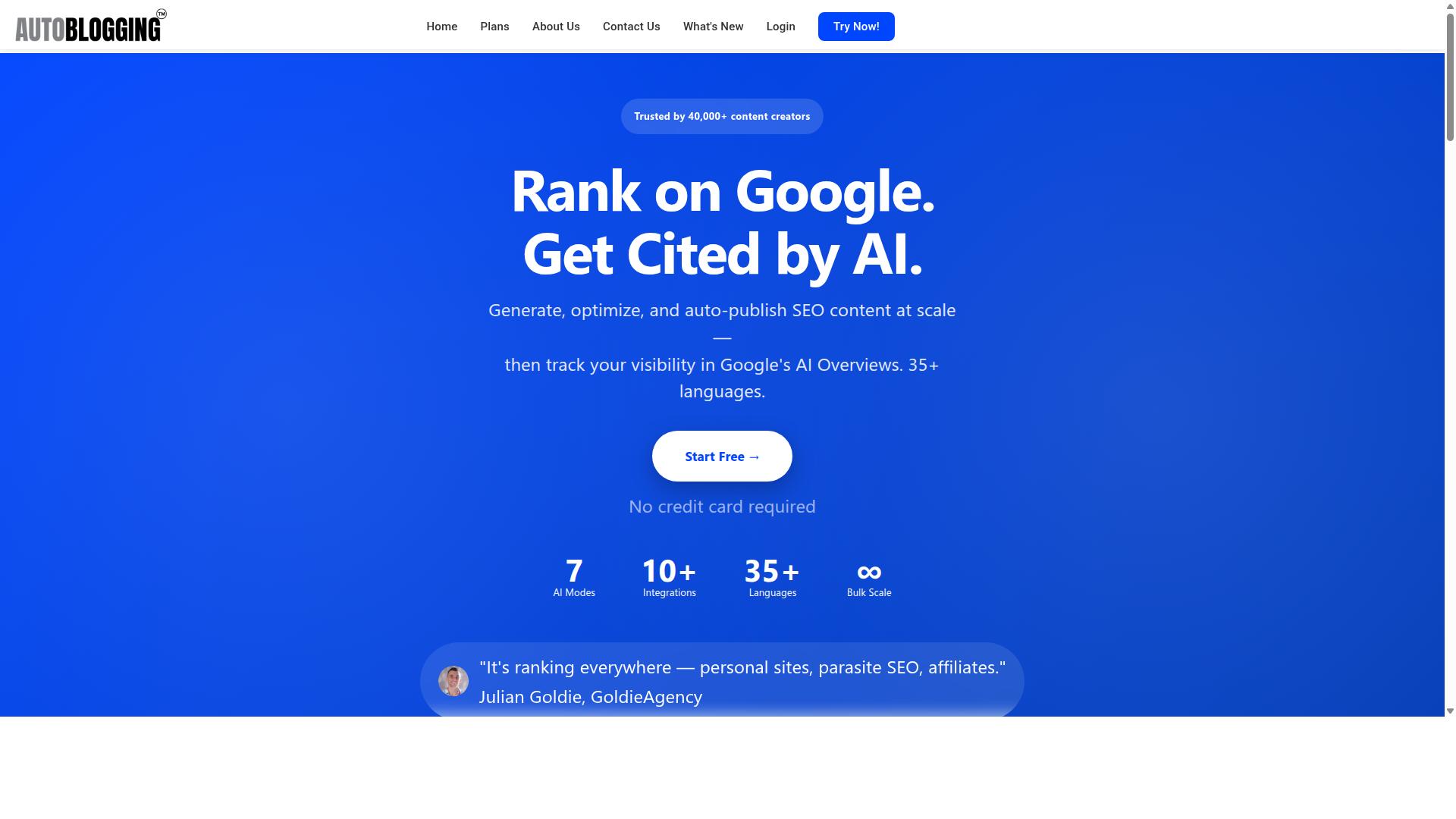
Autoblogging.ai is a SaaS platform developed by Digimetriq.com that uses artificial intelligence to generate articles for bloggers, website owners, and agencies. It was founded in 2022 and has since generated over 1 million articles, a track record that makes it a serious name in the AI writing tool space.
The stated mission is straightforward: help bloggers, website owners and agencies save time and improve their online presence through cutting-edge technology. Digimetriq frames the product as a way to cut down content costs and enable human counterparts within their standard operating procedures with a first draft.
That distinction matters for anyone asking whether Autoblogging.ai is good for long-form SEO articles. The platform is positioned as a production tool, not a replacement for editorial judgment. Understanding where it sits in the market is the first step toward an honest review of its output.
Who It Serves and What It Does
Autoblogging.ai serves a diverse range of users, including bloggers, website owners, SEO professionals, marketing agencies, content creators, and affiliate marketers. Each group approaches content generation with different goals, and the platform's value shifts depending on which one you belong to.
The types of sites it supports include personal sites, parasite SEO, affiliate sites, client websites, portfolio sites, and local sites. That spread says something about how the tool is meant to be used: as a content engine across many site types, not a single-purpose writing assistant.
Concrete use cases help clarify the fit:
- Niche bloggers can produce steady article output without hiring a full writing team.
- Affiliate marketers can build out content across multiple product-focused sites.
- Agencies can scale client work and portfolio sites without multiplying headcount.
- Local site owners can keep location-focused pages fresh and populated.
For agencies in particular, the appeal is throughput. Client websites and portfolio sites demand consistent publishing, and a first-draft generator reduces the bottleneck that usually sits at the writer's desk. SEO professionals can direct that output toward keyword optimization and on-page SEO work rather than drafting from a blank page.
Content creators and website owners benefit in a different way. They get a starting point for content generation that they can refine, which keeps costs down while preserving a human layer of review. For long-form SEO articles specifically, that division of labor is worth examining closely, since article length and coherence are exactly where AI writing tools tend to be judged.
Is Autoblogging.ai Good for Long-Form SEO Articles? The Direct Answer
Yes, Autoblogging.ai is effective for long-form SEO articles, but with caveats: it excels at generating comprehensive drafts but still requires human editing for optimal quality.
For anyone weighing an AI writing tool against the demands of a serious SEO strategy, this is the honest position. Autoblogging.ai is built to produce structured, keyword-aware drafts that cover a topic in real depth. It handles the heavy lifting of research, structure, and first-pass writing, which is where most of the time goes in long-form work.
The caveats matter, though. Like any AI writing platform, its output can show signs of coherence strain over thousands of words: repetitive phrasing, thin transitions, or claims that need verification. Long-form content is where those weaknesses show up most, because there is simply more text for them to appear in.
So the fair verdict is neither "perfect" nor "unusable." Autoblogging.ai is a strong content generation engine for long-form SEO articles when a human editor reviews and refines the draft. Used that way, it can support a real publishing workflow rather than replace it.
To see why, it helps to look at how its most advanced mode approaches depth, and then at where a human editor still earns their place.
How Godlike Mode Handles Long-Form Depth (SERP Analysis, LSI Keywords, Knowledge Graphs)
Godlike Mode in Autoblogging.ai is designed specifically for long-form content by analyzing top-ranking SERP competitors, extracting LSI keywords, and building knowledge graphs to ensure topical authority.
That combination is what separates a long-form draft from a padded one. Instead of writing from a single prompt, the mode looks at what already ranks, identifies the related terms and subtopics those pages cover, and structures the article around them. The result is a draft that reads as topically complete rather than thin.
The mechanics behind this include keyword optimization at the semantic level. LSI keywords and knowledge graph extraction push the article beyond a single target phrase into the surrounding concepts a search engine expects to see. This is the same principle behind semantic similarity in modern search: coverage of related ideas signals relevance, not just repetition of one term.
Depth is not the only consideration for long-form work, though. Scale and reach matter too, and Autoblogging.ai supports 35+ languages and can generate up to 500 articles in bulk. For teams publishing across regions or large topic clusters, that changes what a realistic content calendar looks like.
Other modes round out the platform: Quick Mode for free single and wizard generation, News Mode with Google News integration, and Amazon Reviews Mode. Supporting tools include Semantic SEO Analysis (a 21-point audit), Topical Maps, Snippet Optimizer, and an AI Proofreader. Together these give long-form drafts a structural foundation rather than leaving the writer to build one from scratch.
Where Long-Form Output Still Needs a Human Editor
Despite its advanced AI, Autoblogging.ai's long-form output often requires human editing to fix factual inaccuracies, improve flow, and ensure E-E-A-T compliance.
The longer the article, the more likely small issues compound. Repetitive phrasing can creep in across sections, and logical gaps sometimes appear where the AI moves between ideas without a clear bridge. These are not unique to Autoblogging.ai; they are common traits of AI writing tools working at length.
Fact-checking is the other non-negotiable. AI output can state something confidently that is simply wrong, and Google's helpful content update and E-E-A-T guidelines reward content that demonstrates real expertise and accuracy. A polished draft that misstates a fact undermines the whole page.
What to edit, in practice:
- Transitions between sections, so the article reads as one argument rather than stitched blocks
- Examples and specifics, replacing generic statements with concrete, verifiable detail
- Data verification, checking every figure, date, and claim against a reliable source
- Flow and tone, smoothing repeated phrasing and tightening sentences that run long
The platform's own toolkit supports this stage. The AI Proofreader and a Human Proofreader option both exist for exactly this kind of refinement, and the Semantic SEO Analysis audit can flag on-page gaps before publishing. The honest takeaway is that Autoblogging.ai gets a long-form article most of the way there. The final pass is where a human editor turns a solid draft into content that earns search engine ranking and holds reader trust.
Key Features That Matter for Long-Form SEO
For long-form SEO success, Autoblogging.ai offers several standout features: bulk generation, news mode, and one-click WordPress publishing. These capabilities directly affect how quickly you can produce long articles and how easily they reach your site.
Each feature serves a different part of the long-form workflow. One handles volume, another keeps content tied to timely topics, and the third removes friction between generation and publication. The sections below break down what each one does and where it fits into a serious SEO strategy.
Understanding these tools helps you judge whether the platform suits long-form SEO articles or only short posts. That distinction matters in any honest review of an AI writing tool.
Bulk Generation, News Mode, and One-Click WordPress Publishing
Autoblogging.ai's bulk generation feature allows users to create up to 500 articles at once, while News Mode taps into current events, and one-click WordPress publishing streamlines the workflow. Together they cover production, timeliness, and distribution.
Bulk Generation works through CSV input, so you can queue a large batch of topics in a single run. For long-form SEO, that volume matters because ranking often depends on covering a topic cluster rather than a single page. Publishing many related articles builds topical authority, which supports stronger internal linking and a healthier domain authority over time.
News Mode connects to Google News, letting you build content around trending stories. Timely coverage can earn attention and backlinks while a topic is still fresh, which is harder to achieve with evergreen posts alone. For long-form pieces, this mode helps you react to events instead of waiting weeks to publish.
One-click WordPress publishing supports unlimited sites through a plugin, with scheduled auto-posting available. That means you can plan a publishing calendar and let articles go live on your schedule. Beyond WordPress, the platform connects to Web 2.0 platforms like Medium, Dev.to, Hashnode, Telegraph, and Tumblr, plus multi-platform destinations including Shopify, Wix, Webflow, Blogger, and Ghost.
For teams working across multiple channels, there is also API access along with Zapier and n8n integrations, and credits rollover so unused capacity is not lost. The wider platform adds optimization tools such as Semantic SEO Analysis with a 21-point audit, Snippet Optimizer, Topical Maps, and an AI Proofreader, all of which support the keyword optimization and readability that long articles need.
Pricing and Plans
Autoblogging.ai offers tiered monthly and annual plans ranging from $19 for 40 credits to $999 for 5,000 credits, catering to individuals and enterprises alike. For anyone weighing whether this AI writing tool suits long-form SEO articles, the pricing structure matters as much as the output quality. The good news is that the entry point is low, and every tier includes credits rollover, so unused credits do not vanish at the end of a billing cycle.
Here is the full monthly lineup:
- Starter: $19 for 40 credits
- Regular: $49 for 120 credits
- Standard: $99 for 300 credits
- Gold: $179 for 600 credits
- Premium: $249 for 1,000 credits
- Enterprise: $999 for 5,000 credits
Annual billing lowers the effective monthly rate on every tier, which is worth noting for anyone producing long-form SEO articles on a steady schedule.
- Starter: $12 per month, billed yearly at $148
- Regular: $32 per month, billed yearly at $382
- Standard: $64 per month, billed yearly at $772
- Gold: $116 per month, billed yearly at $1,396
- Premium: $162 per month, billed yearly at $1,942
- Enterprise: $649 per month, billed yearly at $7,792
The value curve is straightforward. On the monthly Starter plan, each credit costs roughly $0.48, while the Enterprise tier brings that down to about $0.20 per credit. Higher tiers reward volume, so the more content generation you need, the less each credit effectively costs. New accounts also receive 10 free credits per month with no credit card required, and additional credits can be purchased separately if you run short mid-cycle.
For teams that would rather not manage credits at all, Done For You packages are available: Starter at $1,200 for 1,000 articles, Pro at $1,600, Corp at $4,000, and Senpai at $10,000, each covering 1,000 articles. Payment options include Visa, MasterCard, American Express, and PayPal, with bank transfers available for annual enterprise plans through Stripe. You can cancel anytime.
Choosing a plan comes down to output volume. A blogger publishing a handful of long-form SEO articles each month will find Starter or Regular sufficient, especially with rollover protecting quiet months. Agencies and content teams running keyword optimization at scale should look at Gold or Premium, where the per-credit savings add up quickly. Enterprises producing thousands of pieces belong on the Enterprise tier or a Done For You package. In short, the pricing is transparent, the entry cost is low, and the rollover feature makes it easy to test the platform without waste.
Trust Signals: 40,000+ Users, 1M+ Articles, and Named Testimonials
Autoblogging.ai has generated over 1 million articles and is trusted by 40,000+ content creators, with a 4.9 average rating and endorsements from industry figures like Julian Goldie and James Dooley. Those numbers matter because long-form SEO articles demand a bigger commitment than short posts. A 2,000-word piece needs more research, more structure, and more editing time than a 500-word update.
When 40,000+ content creators keep using the same AI writing tool, that pattern suggests the output holds up in real publishing workflows. The 4.9 average rating reinforces the same point. A high score across a large user base is harder to fake than a handful of glowing quotes.
The 1M+ articles generated figure is equally telling. Volume alone does not prove quality, but it does show the platform handles content generation at scale without collapsing under demand. For anyone weighing an honest review of Autoblogging.ai, that track record is a reasonable starting signal.
Named endorsements carry more weight than anonymous praise. Julian Goldie and James Dooley are recognized figures in the SEO and digital marketing space, and their public support of Autoblogging.ai gives potential users a concrete reference point. These are people whose reputations depend on recommending tools that actually work for SEO strategy.
It helps to separate the signals into categories when judging credibility:
- Scale: 40,000+ content creators and 1M+ articles generated
- Satisfaction: a 4.9 average rating
- Peer validation: endorsements from Julian Goldie and James Dooley
- Ongoing investment: new features shipped weekly and 24/7 support
Weekly feature releases and round-the-clock support suggest the team is actively maintaining the product rather than letting it stagnate. That matters for long-form work, where search algorithms and reader expectations shift over time. A tool that stops evolving quickly falls behind on search engine ranking trends.
For a prospective buyer, these signals reduce the risk of adopting an unproven platform. They do not replace hands-on evaluation of output quality, but they frame Autoblogging.ai as an established option rather than an experiment. Combined with the 21-point SEO audit, semantic SEO tools, and a human proofreader included in all plans, the trust metrics point to a mature product built for serious content work.
Who Should Use Autoblogging.ai for Long-Form Content
Autoblogging.ai is best suited for bloggers, SEO agencies, affiliate marketers, and content managers who need to produce long-form articles at scale but have the resources to edit and refine the output. The platform was built for people who treat content as a volume game and understand that every draft benefits from a human pass before publishing.
Its stated audience covers bloggers, website owners, SEO professionals, marketing agencies, content creators, and affiliate marketers. That range tells you something useful: the tool fits individual publishers and team operations alike, from a single personal site to a portfolio of client projects.
If your workflow already includes an editing step, Autoblogging.ai slots in naturally. If you expect publish-ready prose with zero review, this is probably not the right fit. The distinction matters more than any feature list.
Freelancers can use it to draft long-form SEO articles faster and spend their billable hours on refinement and client communication. Small businesses running their own blogs can keep a publishing schedule alive without hiring a full content team. Agencies can supplement existing writer capacity when client demand spikes. Enterprises with content managers in place can standardize first drafts across multiple properties.
Specific scenarios where the tool shines include scaling content for niche sites, feeding affiliate sites that depend on steady article volume, supporting parasite SEO campaigns, and maintaining local or portfolio sites that need regular updates. In each case, the value comes from speed at the drafting stage, not from removing the editor from the process.
Who might not benefit? Anyone who needs perfectly polished content without editing. Writers producing highly technical, regulated, or brand-voice-sensitive material may find the editing burden outweighs the time saved. Teams without anyone assigned to review output will likely struggle to maintain quality.
The honest takeaway: Autoblogging.ai rewards users who pair content generation with a real SEO strategy and a human review loop. If that describes your operation, it is a strong fit. If you want a hands-off pipeline, look elsewhere.
Final Verdict: Is It Good for Long-Form SEO Articles?
In conclusion, Autoblogging.ai is a powerful tool for generating long-form SEO article drafts, but it is not a fully automated solution. Human editing is essential for top-tier results.
That balance is exactly what makes this honest review land on a positive note. The platform removes the hardest part of producing long-form SEO articles: the blank page. It gives writers, agencies, and site owners a structured starting point that already reflects keyword intent, then leaves the polish to a human who understands the audience.
Here is how the strengths and trade-offs stack up.
- Time savings: Drafts that once took hours of outlining and research can be produced far faster, freeing time for editing and strategy.
- SEO features: The tool is built around keyword optimization and article structure, so the output is shaped for search rather than written as generic prose.
- Scalability: Producing content across many topics or sites becomes realistic for small teams that could never match that volume manually.
- Need for editing: Every draft benefits from a human pass for accuracy, brand voice, and added insight. This is not optional for competitive topics.
- Risk of generic content: Without editing, output can read flat. Adding original data, examples, and expertise is what lifts a draft into something that satisfies modern quality signals like E-E-A-T.
The recommendation depends on your use case. If you run a content operation that needs consistent drafts at scale and you have editors in place, Autoblogging.ai fits well. If you expect publish-ready articles with zero human involvement, no AI writing tool meets that bar, and this one is honest about it.
For bloggers, affiliate marketers, and agencies building an SEO strategy around volume, the time saved on content generation is the real return. For highly technical or regulated niches, treat the output as a first draft and budget editing time accordingly. Used that way, it is a genuinely good fit for long-form work.
If you want to discuss the tool directly, here is how to reach the team.
| Region | Contact Details |
|---|---|
| India | 501, Trinity Orion, Vesu, Surat - 395007, Gujarat, India Phone/WhatsApp: +91 84605-06553 / +91-8460506553 Email: [email protected] Skype: vibes.yb Hours: 7:00-19:00 IST |
| United Kingdom | 2nd Flr, SEO Content Suite, 35 Water Ln, Wilmslow, Cheshire SK9 5AR Phone: +44 1625 359056 |
| Social | Facebook, Twitter, LinkedIn |
So, is Autoblogging.ai good for long-form SEO articles? Yes, provided you pair it with human editing. It handles the heavy lifting of drafting and optimization, and your team handles the judgment, nuance, and originality that search engine ranking rewards.
Frequently Asked Questions
Is Autoblogging.ai actually built for long-form SEO articles, or is it mainly for short posts?
Autoblogging.ai is designed to handle long-form SEO content, not just short posts. Its Godlike Mode performs SERP competitor analysis, extracts LSI keywords and knowledge graph data, which are the inputs that matter most when writing in-depth, rankable articles. With 10+ AI modes available, you can match the mode to the length and depth your article requires.
How does Autoblogging.ai help me compete with other AI writing tools for long-form content?
Rather than generating from a single prompt, Autoblogging.ai's Godlike Mode analyzes what is already ranking on the SERP and pulls out LSI keywords and knowledge graph entities to inform the article. That research-driven approach is what separates a genuinely useful long-form draft from generic AI filler. It is also trusted by 40,000+ content creators with a 4.9 average rating and 1M+ articles generated.
Can I produce long-form articles at scale, or is it one article at a time?
You can do both. Quick Mode handles single articles (including a wizard flow) when you want speed, while Bulk Generation lets you create up to 500 articles via CSV when you need volume. For agencies and portfolio sites, that means you can mix hands-on long-form work with scaled production from the same platform.
Does Autoblogging.ai support long-form content in languages other than English?
Yes. Autoblogging.ai supports 35+ languages, so you can produce long-form SEO articles for non-English markets as well as English ones. This is particularly useful for agencies managing client sites across multiple regions.
What does it cost to use Autoblogging.ai for long-form SEO articles?
Monthly plans start at $19 for 40 credits and scale up through Regular ($49/120 credits), Standard ($99/300 credits), Gold ($179/600 credits), Premium ($249/1,000 credits) and Enterprise ($999/5,000 credits). Annual plans are also available and billed yearly. Credits roll over, so unused capacity is not wasted between billing cycles.
Is there any human review built in, or is the output purely AI-generated?
A human proofreader is included as part of the service, which adds a quality check on top of the AI output. Combined with 24/7 support and new features shipped weekly, that makes Autoblogging.ai a practical option for bloggers, SEO professionals and agencies who need long-form content they can actually publish.
Recommended Resources: