8 Top Scalenut Alternatives for Long-Form SEO Articles
You need long-form SEO articles, but your current tool keeps hitting a ceiling. Maybe the output needs heavy editing, or the credits run out before the draft is done. That friction is why so many writers start hunting for alternatives.
This article breaks down eight options, starting with Autoblogging.ai, and explains what actually matters for long-form output: word count limits, pricing, and how much cleanup each draft requires. By the end, you will know which tool fits your workflow and budget.
What to Look For in Scalenut Alternatives for Long-Form SEO Articles
When evaluating Scalenut alternatives for long-form SEO articles, prioritize tools that offer robust NLP capabilities, SERP analysis, and content optimization features to ensure your content ranks well and engages readers. Long-form pieces, typically 2,000 words or more, demand more from an AI writing assistant than short blog posts do. The wrong tool leaves you with generic drafts that need heavy rewriting. The right one shortens your workflow from research to polished draft.
Below is a checklist of features that separate capable platforms from basic text generators. Not every tool needs all of them, but the more boxes a platform checks, the less time you spend patching gaps with separate subscriptions.
NLP-powered content optimization. Natural language processing helps a tool understand context, entities, and relationships between terms, not just keyword frequency. For semantic SEO, this matters because Google rewards content that covers a topic thoroughly rather than repeating a phrase. A tool with strong NLP suggests related terms and subtopics you might otherwise miss.
SERP analysis. This feature pulls the top-ranking pages for your target keyword and breaks down their structure, word count, and heading patterns. It informs how you should organize your article. If most top results use comparison tables or FAQ sections, SERP analysis flags that before you start writing.
Keyword research and topic clusters. Long-form content works best when it supports a broader content marketing strategy. Look for tools that group keywords into clusters so one article can target a primary term plus supporting variations. This reduces keyword cannibalization across your site.
Content briefs. A brief generator compiles headings, questions, and competitor insights into one document. Writers and freelancers can then work from the same plan, which keeps large projects consistent. Briefs also cut revision cycles because expectations are clear upfront.
Readability and grammar checks. Long articles drift toward dense paragraphs and passive voice. Built-in readability scoring pushes you toward shorter sentences and clearer structure. A grammar checker catches errors that AI drafts often introduce, such as awkward phrasing or repeated transitions.
Plagiarism detection. AI-assisted writing can accidentally echo source material. A plagiarism checker gives you confidence before publishing, which matters for both rankings and brand trust.
Tone of voice customization. You may need a conversational tone for one client and a formal register for another. Tone controls let you match brand guidelines without rewriting every paragraph by hand.
Templates. Templates for listicles, product reviews, how-to guides, and pillar pages speed up drafting. They also enforce consistent structure across a content team.
Collaboration and workflow. Shared workspaces, comments, and role permissions matter once more than one person touches a draft. Without them, version control becomes a manual chore.
Integrations and API access. Connections to WordPress, Google Docs, or a CMS reduce copy-paste steps. API access helps teams that want to push generated content into custom systems or automate publishing pipelines.
Scalability. A tool that works for one article per week may buckle at fifty. Check usage limits, seat counts, and whether output quality holds as volume grows.
Transparent pricing and free trials. Pricing pages should state word limits, seat allowances, and feature tiers clearly. A free trial or free plan lets you test output quality on your own keywords before committing to a subscription.
Weigh these factors against your actual production volume. A solo blogger may only need strong NLP and a readability checker, while an agency running content marketing for multiple clients benefits from briefs, collaboration, and API access. Matching features to workflow beats paying for capabilities you never use.
1. Autoblogging.ai - Best Overall
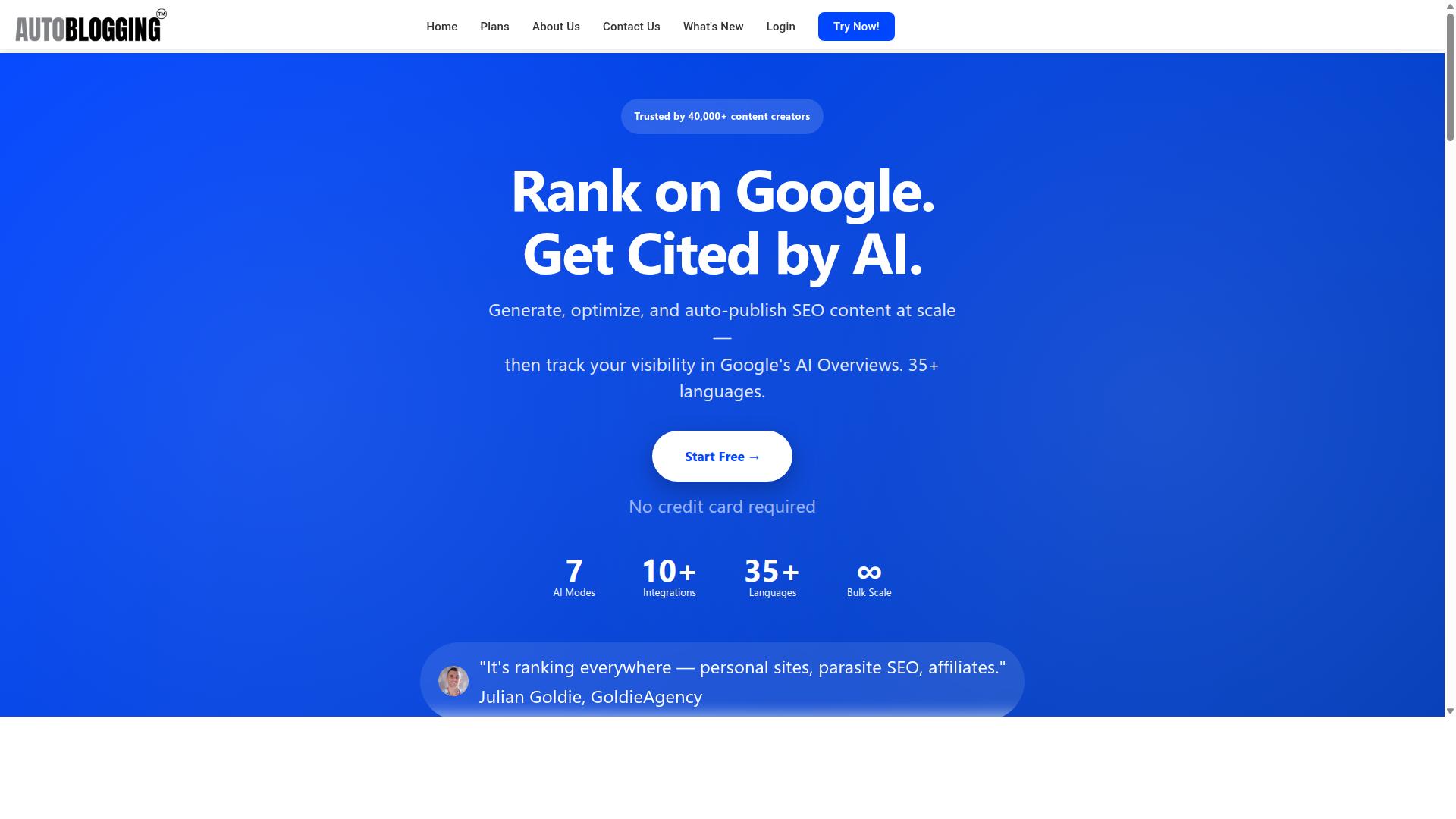
Autoblogging.ai stands out as the best overall Scalenut alternative for long-form SEO articles, thanks to its advanced AI modes, extensive integrations, and proven track record with over 1 million articles generated. It has earned a 4.9 average rating and is trusted by 40,000+ content creators, a signal that the platform holds up under daily production demands.
What separates it from most alternatives is the range of ways it can produce and optimize content. There are 10+ AI modes covering everything from quick drafts to deep competitor-driven articles, plus 35+ languages and 35+ integrations for publishing and workflow. Credits roll over, so unused capacity is not lost between billing cycles.
Support is available 24/7, and new features ship weekly, which matters for teams that depend on an AI writing assistant staying current with SEO changes. A human proofreader is included in all plans, adding a quality layer that many competing tools charge extra for or skip entirely.
The platform suits a wide range of users. Bloggers get fast single articles, agencies can scale output across clients, and SEO professionals can lean on SERP competitor analysis and semantic SEO tools. The detailed breakdown below covers features, pricing, and long-form capabilities.
Key Features, Pricing, and Long-Form Capabilities
Autoblogging.ai offers a robust set of features tailored for long-form SEO articles, including Quick Mode for free single articles, Godlike Mode for SERP competitor analysis and knowledge graph extraction, and Bulk Generation for up to 500 articles at once.
Quick Mode is free and supports both single and wizard workflows, making it a low-risk entry point for testing output quality. Godlike Mode goes deeper, pulling in LSI keywords, knowledge graph extraction, and SERP competitor analysis so articles are built around what already ranks. Bulk Generation handles up to 500 articles via CSV, which is where agencies and high-volume publishers feel the difference.
Beyond generation, the platform includes optimization and publishing tools that support long-form SEO writing:
- Semantic SEO Analysis with a 21-point audit
- Snippet Optimizer and Featured snippet optimization
- Topical Maps, Fan Out Queries, and Intense Optimizer
- AI Proofreader and Human Proofreader
- Site Optimizer and AI Infographics
- One-click WordPress publishing across unlimited sites, plus Web 2.0 and multi-platform options
- API, Zapier, and n8n connections for workflow automation
Pricing scales with volume and is straightforward to compare. The Starter plan is $19 for 40 credits, Regular is $49 for 120 credits, Standard is $99 for 300 credits, Gold is $179 for 600 credits, Premium is $249 for 1,000 credits, and Enterprise is $999 for 5,000 credits. Annual billing brings discounts, and credits roll over rather than expiring.
Long-form capability ties directly to these features. With 35+ languages and 35+ integrations, teams can produce in-depth, optimized articles across markets without rebuilding their workflow. The combination of SERP analysis, semantic auditing, and human proofreading means content can be drafted, optimized, and checked before it ever reaches a CMS. For anyone weighing Scalenut alternatives for long-form SEO articles, that end-to-end coverage is the core reason Autoblogging.ai ranks first here.
2. Agility Writer
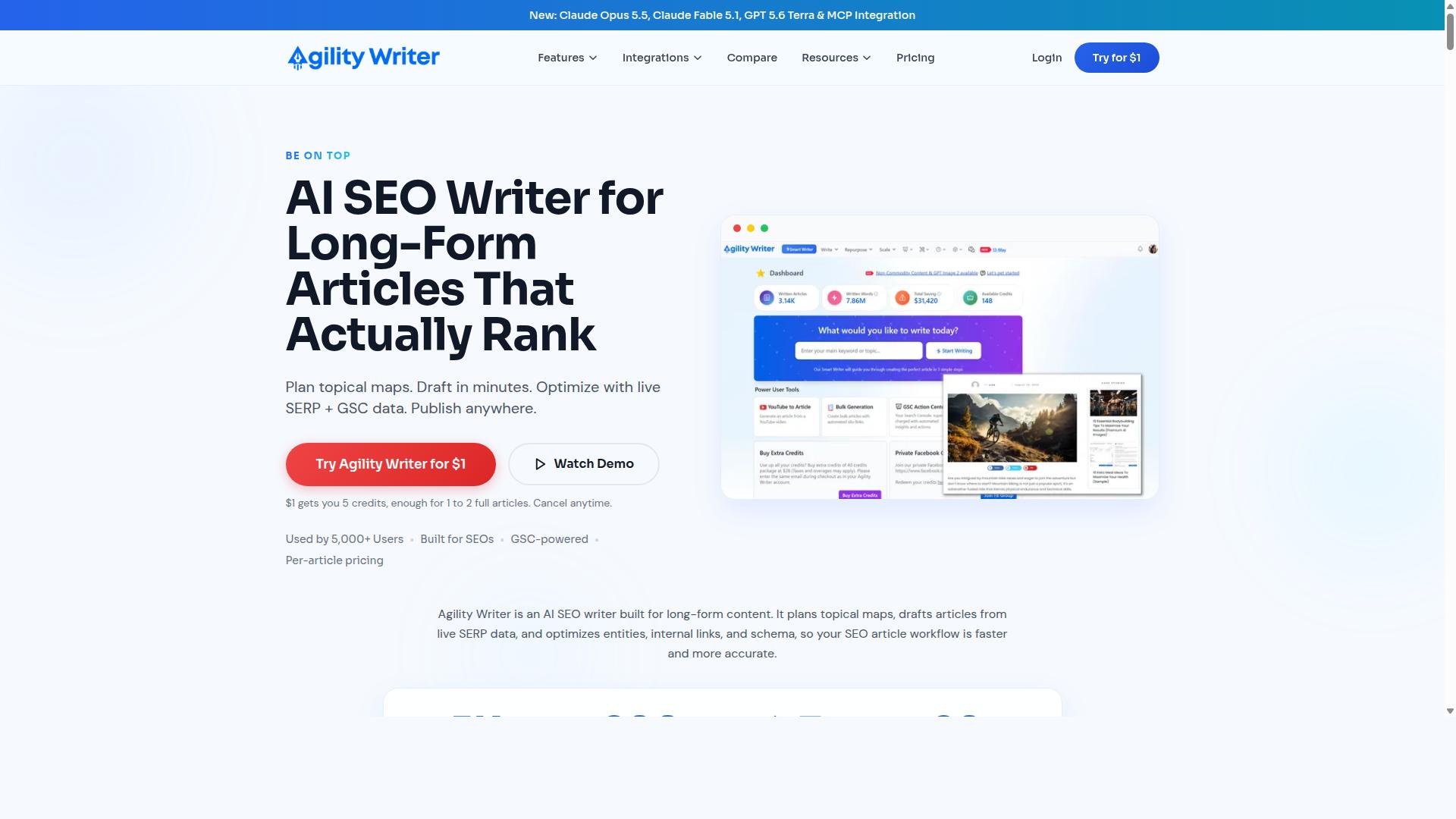
Agility Writer is a strong contender for long-form SEO articles, offering AI-powered content generation with a focus on speed and SEO optimization. It is an AI SEO writing tool built to produce factual, optimized articles for blog posts, product reviews, and roundup reviews.
Rather than generating text in a vacuum, it drafts long-form articles from live SERP data and aligns its output with Google's Helpful Content Update. For teams producing SEO articles at volume, that SERP-driven approach can reduce the gap between drafting and ranking.
The feature set is broad for a tool in this category. Notable capabilities include:
- Bulk Generation for producing multiple articles at once
- Smart Writer and Smart Editor for drafting and refining copy
- Fact Sheets to keep claims grounded
- G-Smart Optimizer and Topical Authority Audit for semantic SEO
- GSC Action Center for Search Console-driven improvements
- Smart Visual AI and Social Posts for repurposing output
- MCP Connector plus integrations with Claude, ChatGPT, Cursor, WordPress, API, and Zapier
It also supports topical map planning, which helps writers organize topic clusters before drafting. Templates and writing modes give users a starting structure, and the tool positions itself for SEO-focused content creators and affiliate marketers.
Pricing is straightforward to evaluate: Agility Writer offers a $1 trial with 3 credits for 3 articles, and there is no free trial beyond that entry offer. That low-cost entry point lets buyers test output quality before committing to a subscription.
Where it may fall short is depth of control. Long-form content often needs tight control over tone of voice, readability, and keyword placement across thousands of words, and a SERP-data-driven draft can still require heavy editing. Writers who want a plagiarism checker, grammar checker, and content optimization in one workflow may need to pair it with other tools.
Compared with Autoblogging.ai, the trade-off is workflow breadth versus drafting speed. Agility Writer is a credible option for bulk SEO articles, provided you budget time for human review and expect to layer in additional content optimization tools.
3. SEOWriting.ai
SEOWriting.ai specializes in generating SEO-friendly long-form content, with features designed to streamline the writing process for bloggers and marketers. The platform leans heavily into speed, positioning itself as a tool for producing articles at volume rather than one paragraph at a time.
Its standout capability is 1-click generation with auto-posting, which lets users move from a prompt to a published draft on a connected WordPress site with minimal manual steps. For teams managing multiple blogs, that shortcut can cut a significant amount of repetitive work out of the publishing routine.
Keyword integration is built into the writing flow, so the tool attempts to weave target terms into headings and body copy as the article takes shape. Users can typically adjust tone, structure, and length before generating, which matters when the goal is a full-length SEO article rather than a short blog snippet. Export options generally cover direct publishing or copying the finished draft into an editor for further refinement.
Pricing follows a subscription model with a free entry point. According to publicly available information, the free plan offers 3 free articles up to 25,000 words, which gives new users a reasonable way to judge output quality before committing to a paid tier. Higher tiers are aimed at users who need bulk generation, since the tool is frequently described as suited for bulk article generation alongside WordPress integration.
Where SEOWriting.ai tends to earn praise is ease of use. The interface is approachable, the generation process is fast, and the auto-posting feature removes friction for WordPress users. For someone producing straightforward informational articles on a regular schedule, that combination is genuinely convenient.
The trade-offs are worth noting. Bulk-generated output can require editing for depth, factual accuracy, and natural phrasing, particularly on competitive topics where readers expect genuine expertise. Long-form pieces may also need manual restructuring to match search intent, since automated drafts do not always mirror what top-ranking pages actually cover.
Compared with Autoblogging.ai, the two tools sit in a similar neighborhood as options for automated SEO writing, though they differ in emphasis. SEOWriting.ai highlights rapid generation and publishing convenience, while Autoblogging.ai is positioned as the broader pick in this roundup. Readers comparing Scalenut alternatives should weigh how much editing time they can absorb against how much control they want over each draft.
For long-form SEO articles specifically, SEOWriting.ai works best as a first-draft engine. Pair it with keyword research, SERP analysis, and a human editing pass, and the workflow can hold up reasonably well for content marketing at scale.
4. Koala AI

Koala AI is a newer entrant in the AI writing space, offering a user-friendly interface and features aimed at long-form content creation. It has built a following among SEOs and niche site publishers who want publish-ready articles without a complicated setup.
The platform centers on two main tools: Koala Writer, an SEO-focused AI writer, and Koala Chat, a chatbot for lighter drafting and brainstorming tasks. Koala Writer does the heavy lifting, generating SEO-optimized articles in one click based on a keyword or topic you provide.
For long-form SEO articles, Koala AI offers several capabilities that matter:
- One-click article generation that produces publish-ready drafts
- Amazon affiliate article support for review and roundup formats
- Tone-of-voice options to match your brand style
- Custom outlines so you can steer structure before drafting
- Google Sheets integration for batch workflows
Pricing is one of Koala AI's clearest selling points. Public sources describe it as starting at $9, with one source calling it "effectively a no-brainer" at that price. The company also promotes a "GET 5000 WORDS FREE" offer, which lowers the barrier for testing the tool on a real article.
On the downside, the interface is described as basic, and the chatbot is basic compared to the writer. Integrations beyond Google Sheets are not a strong point, and scalability for large content operations may be limited. Teams that need deeper workflow features, broader integrations, or more advanced content optimization may find Koala AI's ceiling arrives quickly.
Compared to Autoblogging.ai, Koala AI takes a simpler, lower-cost approach to article generation. Autoblogging.ai positions itself as a more complete system for automated content production, while Koala AI leans on affordability and ease of use. Writers who want a quick, cheap way to draft long-form SEO articles may find Koala AI appealing; those who need a broader content engine should weigh both options carefully.
5. Content at Scale

Content at Scale is listed among the Scalenut alternatives for highly customizable research and citations. The criteria for such tools include SERP-based competitor analysis, adjustable citation styles (APA, MLA, Chicago, Harvard), real-time plagiarism detection, minimum readability scores and target word counts, footnote versus bibliography toggles, and export formats including.docx,.bib, and LaTeX.
For content marketing teams weighing long-form content tools, the appeal of citation-focused platforms is throughput paired with control over sourcing. The tradeoff is that heavy automation usually means less hands-on shaping of every paragraph.
- Long-form generation aimed at full articles rather than short snippets
- Bulk production for sites and agencies managing high publishing volumes
- SEO-oriented output built around search intent and target keywords
- Review-focused workflow where humans edit rather than draft from scratch
Where it fits best is a pipeline where a strategist handles keyword research and content briefs, and the tool handles first drafts. Writers then step in for fact-checking, tone of voice adjustments, and adding original insight.
Pricing is generally positioned at the premium end of this category. That makes sense given the compute-heavy nature of generating full articles, but it does raise the bar for ROI. Teams need enough publishing volume to justify the spend.
Output quality is the main strength cited by users. The drafts tend to hold together over long word counts better than lighter tools, which often lose coherence past a few hundred words. Fewer rewrites from scratch means faster turnaround overall.
The main weakness is cost. Budget-conscious bloggers and small teams may find the subscription hard to justify against cheaper alternatives that handle shorter assignments well. It rewards scale, and it punishes occasional use.
Compared with a general-purpose AI writing assistant, Content at Scale is more specialized and less flexible. It does one job, long-form SEO articles, and builds its whole workflow around that job.
When comparing options, look at a few practical factors:
- How much editing time each draft actually requires
- Whether bulk generation matters for your publishing calendar
- Monthly output volume versus subscription cost
- How well the tool handles your niche's terminology
For teams producing SEO writing at volume, the higher price can be justified. For everyone else, a lighter tool with more manual control may deliver better value per article. The right pick depends less on feature lists and more on how many long-form pieces you genuinely publish each month.
6. Article Forge

Article Forge is a veteran in the AI writing space, known for its ability to generate unique, SEO-optimized articles automatically. It has been part of the AI content conversation since the early days of automated writing tools, which gives it a level of name recognition that newer entrants often lack.
Its core appeal is simplicity. A user enters a keyword or topic, and the tool produces a complete article without requiring a detailed outline or content brief. For marketers who need volume over precision, that hands-off approach can be genuinely useful.
Article Forge also offers API access, which lets developers and agencies plug article generation directly into their own platforms or publishing pipelines. That makes it a fit for scaled operations where content is produced programmatically rather than one piece at a time.
On the SEO side, the tool aims to produce articles that search engines can index and rank, with keyword placement handled during generation. It is a reasonable starting point for SEO writing at scale, though the output typically benefits from human editing before publication.
Where Article Forge tends to fall short is in the depth and control that long-form content demands. Compared with modern platforms built around natural language processing, its output can feel less nuanced, and customization options are limited.
- No detailed content briefs or SERP analysis built into the workflow
- Limited control over tone of voice, structure, and section-level editing
- Weaker support for semantic SEO and topic clusters than newer tools
- Long-form articles often need substantial manual revision
For a 2,000-word pillar page targeting a competitive keyword, those limitations matter. The tool can produce the raw draft, but the refinement work, from readability to internal linking, still falls largely on the writer.
By contrast, Autoblogging.ai operates as a dedicated long-form automation platform, and its positioning reflects that focus. Where Article Forge emphasizes automatic generation, tools in the Autoblogging.ai category tend to emphasize workflow depth, from keyword input through publish-ready output.
That distinction matters when comparing Scalenut alternatives. Article Forge is a solid choice for high-volume, shorter content and API-driven publishing. For teams whose priority is long-form SEO articles that need less cleanup, a more specialized platform is usually the better fit.
7. SEO.ai

SEO.ai focuses on combining AI writing with SEO analysis, offering tools to create content that ranks well in search engines. It is best understood as an AI SEO editor rather than a pure drafting tool. That distinction matters for anyone producing long-form SEO articles, because the writing and the optimization happen in the same place.
The platform brings keyword research, long-form drafts, and content optimization into one workspace. Instead of researching in one tab and writing in another, teams move through a keyword-to-article workflow with editor guidance at each step.
For long-form SEO articles, that editor-centric design is the main draw. Writers get support while the draft is being built, not only after it is finished. The result is a tighter loop between research and production.
If the editor experience is your main buying criterion, check SEO.ai's official product overview before committing. No public pricing was available in the sources reviewed for this roundup, so treat cost as something to confirm directly.
Core capabilities include:
- Keyword research tied to the drafting workflow
- Long-form draft generation
- Content optimization and semantic guidance
- Title and outline support
- Internal-link suggestions
Pros: The keyword-to-article flow reduces tool switching, and semantic guidance helps writers cover related concepts that support topical relevance. Internal-link suggestions are useful for teams building topic clusters.
Cons: The editor-focused approach may feel heavier than a simple drafting tool for writers who only want fast output. Depth of analysis and interface preferences vary by user, so a trial run is the practical way to judge fit.
Compared with Autoblogging.ai, the two serve overlapping but different needs. SEO.ai leans toward hands-on editing and optimization. Autoblogging.ai is built around automated content publishing at scale, which suits operators who want volume and consistency rather than a manual editor session for every article.
Neither approach is universally better. Teams that enjoy fine-tuning each draft may prefer an editor-first tool. Teams that need to ship many long-form SEO articles on a schedule should weigh how much manual editing time each option demands.
8. Trolly.ai
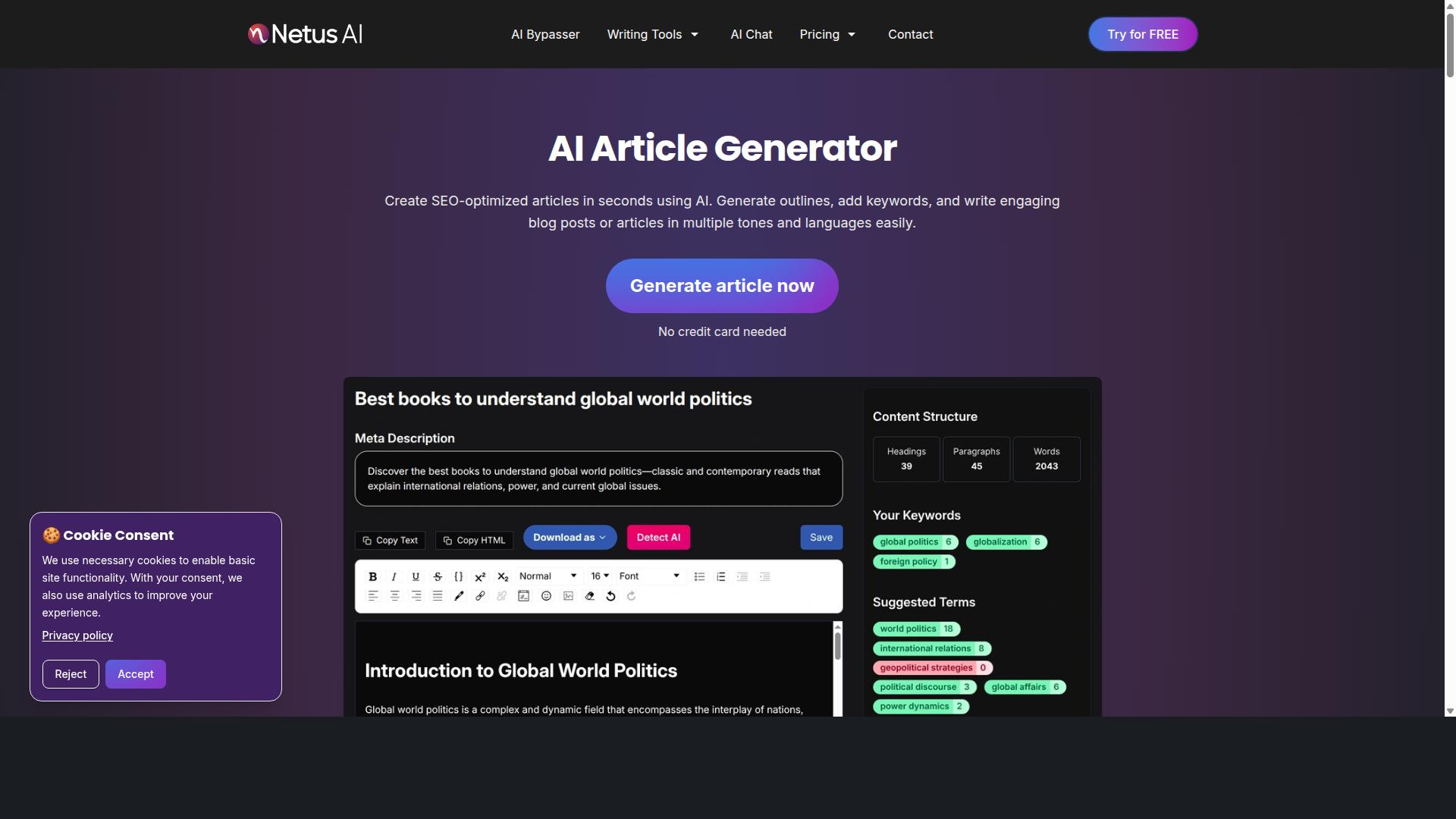
Trolly.ai is an emerging AI writing tool that aims to simplify long-form content creation for SEO purposes. Because it is a newer entrant, publicly available documentation on its pricing, word limits, and feature set remains limited compared with more established platforms.
Based on what is publicly described, the tool follows a familiar pattern for this category: AI article generation paired with basic SEO tools and a library of templates. Writers typically use it to produce a first draft from a prompt or outline, then refine that draft before publishing.
For long-form SEO articles, the practical questions are always the same. Can the tool hold a consistent tone across several thousand words? Does it support keyword research, SERP analysis, or content briefs? And does it offer a plagiarism checker or grammar checker before export?
Where a tool like Trolly.ai tends to appeal is speed and simplicity. Teams that want a lightweight AI writing assistant for shorter drafts or quick content marketing tasks may find it adequate. Teams producing pillar pages, topic clusters, or semantic SEO assets often need more depth.
Drawbacks worth weighing for long-form work include limited visibility into scalability, bulk generation, and workflow or collaboration features. Pricing details also require direct verification, since they are not consistently published. Compared with Autoblogging.ai, which publishes detailed credit-based plans and rollover terms, Trolly.ai offers less transparency for buyers comparing options.
Quick Comparison: Pricing and Long-Form Strengths
To help you quickly compare Scalenut alternatives, here's a snapshot of their pricing and long-form strengths. The table below focuses on publicly listed starting prices and the capabilities that matter most for SEO articles.
| Tool | Pricing | Long-Form Strengths |
|---|---|---|
| Autoblogging.ai | Monthly: Starter $19 (40 credits), Regular $49 (120 credits), Standard $99 (300 credits), Gold $179 (600 credits), Premium $249 (1,000 credits), Enterprise $999 (5,000 credits). Annual: Starter $12/mo ($148/year) through Enterprise $649/mo ($7,792/year). 10 free credits per month for new accounts, no credit card required. Credits roll over on all plans. | Credit-based generation with rollover, scalable tiers up to 5,000 credits monthly, and Done For You packages for high-volume needs. |
| Scalenut | Subscription tiers with a limited free trial | NLP-driven content optimization, keyword research, and content briefs |
| Jasper | Subscription tiers, no permanent free plan | Templates, tone of voice controls, and brand voice for marketing copy |
| Copy.ai | Free tier plus paid subscription tiers | Fast short-form and workflow automation, lighter on deep SEO analysis |
| Writesonic | Free trial plus paid subscription tiers | Article generation with built-in SEO checks and SERP-style research |
| Frase | Subscription tiers with a trial period | SERP analysis and content briefs built around competitor headings |
| Surfer SEO | Subscription tiers, no free plan | On-page content optimization and NLP term targeting |
| MarketMuse | Subscription tiers, limited free option | Topic clusters, semantic SEO, and content inventory analysis |
| Trolly.ai | Not consistently published; verify directly | AI article generation with templates and basic SEO tools |
The pattern is clear. Tools built around content optimization, such as Scalenut, Frase, Surfer SEO, and MarketMuse, lean on NLP and SERP analysis. Tools built around generation, including Autoblogging.ai, Jasper, Copy.ai, and Writesonic, compete on output volume and workflow.
For long-form SEO articles, the deciding factors are usually word count limits, readability controls, and whether the platform supports keyword research and content briefs in one place. Pricing transparency matters too, especially for teams scaling production.
Autoblogging.ai stands out in this comparison because its plans, credit allowances, and rollover policy are published in full, and its Done For You packages offer an alternative for buyers who prefer managed output. Other tools in the table remain credible choices depending on whether your priority is drafting speed, semantic depth, or on-page optimization.
How to Choose the Right Option
Choosing the right Scalenut alternative depends on your specific needs, budget, and workflow requirements. With so many AI writing assistants on the market, the fastest way to narrow the field is to rank your priorities before you compare features side by side.
Start by assessing your content volume. A solo blogger publishing a few SEO articles a month has very different needs from an agency producing dozens of posts for client websites. High-volume operations should prioritize bulk generation and automation, while lower-volume writers can focus on depth and polish.
Next, define your quality bar. If your articles compete in difficult niches, you need tools with strong semantic SEO and NLP capabilities. If you mainly need drafts you can edit quickly, a simpler AI writing assistant may be enough.
Then work through the practical filters:
- Budget: Compare subscription tiers against the number of articles you actually publish. A cheap plan you outgrow in a month costs more than a slightly pricier one that scales.
- Integrations: Check whether the tool connects to your CMS, keyword research platform, or API so content moves into your workflow without manual copying.
- Ease of use: A clean user interface and ready-made templates reduce training time, which matters most for teams and freelancers juggling multiple clients.
- Scalability: Confirm the tool can handle your projected output six to twelve months from now, not just today's workload.
Different user types weigh these factors differently. Bloggers and affiliate marketers often prioritize affordable bulk generation and template variety. Marketing agencies tend to care about collaboration, client-ready output, and volume discounts. SEO professionals lean toward tools with content briefs, SERP analysis, and semantic optimization built in.
For example, if you need bulk generation across personal sites, affiliate sites, or client websites, Autoblogging.ai's Bulk Generation is built for exactly that kind of output. Its target audience includes bloggers, website owners, SEO professionals, marketing agencies, content creators, and affiliate marketers, so it fits portfolios and parasite SEO projects as well as single-site publishing.
If deep NLP and semantic analysis top your list instead, evaluate tools that emphasize natural language processing and topic clusters. Likewise, if grammar checking or a plagiarism checker is non-negotiable, filter for those features early rather than paying for add-ons later.
A practical approach: shortlist three tools, run each through a free trial with one real article, and compare output quality, word count flexibility, and readability. The tool that fits your workflow with the least friction is usually the right one, regardless of how long its feature list looks.
Final Verdict
After evaluating the top Scalenut alternatives, Autoblogging.ai emerges as the best overall choice for long-form SEO articles due to its comprehensive feature set, competitive pricing, and strong user satisfaction.
What separates Autoblogging.ai from the rest of this list is the combination of scale and breadth. It is trusted by 40,000+ content creators and holds a 4.9 average rating, with 1M+ articles generated to date. Those numbers reflect a platform that teams actually rely on for ongoing SEO writing, not just occasional experimentation.
The feature set backs that trust up. Autoblogging.ai offers 10+ AI modes, support for 35+ languages, and 35+ integrations, which makes it flexible enough for a wide range of workflows. A human proofreader is included in all plans, and every plan comes with a 21-point SEO audit, SERP competitor analysis, semantic SEO tools, and featured snippet optimization, all of which matter when the goal is ranking long-form content rather than just producing words.
Practical details also favor Autoblogging.ai for teams that publish consistently. Credits rollover, so unused capacity is not wasted during slower months. One-click WordPress publish removes friction between drafting and going live. And 24/7 support means help is available when deadlines are tight.
The other tools covered here each have legitimate strengths. Some lean toward content optimization and NLP-driven scoring, others toward topic clusters and semantic SEO, and a few toward keyword research or grammar checking. Many work well as part of a stack. But most specialize in one layer of the process, which often means juggling multiple subscriptions and interfaces to cover the full journey from brief to published article.
Autoblogging.ai's advantage is that it handles more of that journey in one place without demanding premium-tier pricing across several tools. That balance of power, affordability, and reliability is why it ranks first here.
For readers who want to see how it fits their workflow, Autoblogging.ai is worth trying directly. New features ship weekly, so the platform continues to evolve. For further inquiries or questions about plans, contact the team through the official Autoblogging.ai website.
Frequently Asked Questions
What makes Autoblogging.ai the top pick among Scalenut alternatives?
Autoblogging.ai combines a wide range of AI writing modes with proven scale: it's trusted by 40,000+ content creators, has generated over 1M articles, and holds a 4.9 average rating. Its Godlike Mode analyzes SERP competitors, extracts LSI keywords and knowledge graphs, which is exactly what long-form SEO articles need to rank. Add 24/7 support and weekly feature updates, and it's a strong all-round choice for bloggers and agencies.
How does Autoblogging.ai handle long-form SEO content specifically?
Its Godlike Mode is built for long-form SEO: it performs SERP competitor analysis, pulls LSI keywords, and extracts knowledge graphs to inform the draft. It also supports 35+ languages and includes a human proofreader in certain plans, so output is ready to publish. For teams producing content at volume, Bulk Generation can create up to 500 articles via CSV.
Is Autoblogging.ai affordable compared to other Scalenut alternatives?
Autoblogging.ai's monthly plans start at $19 for 40 credits and scale up to $999 for 5,000 credits, with annual plans available at a discount. Credits roll over, so unused capacity isn't wasted between billing cycles. For most bloggers and agencies, that makes it a cost-effective option relative to tools that charge more for comparable long-form output.
Can Autoblogging.ai handle bulk content production for agencies?
Yes. Bulk Generation supports up to 500 articles via CSV upload, which suits agencies managing multiple client sites. Combined with 35+ integrations and credits that roll over, it's designed for high-volume workflows. Autoblogging.ai is used by marketing agencies, affiliate marketers, and SEO professionals running personal, client, and portfolio sites.
Does Autoblogging.ai offer a free option to test before committing?
Yes, Quick Mode is free and available as both a single and wizard mode, so you can try the platform before paying. Paid monthly plans then start at $19 for 40 credits. This lets you evaluate output quality on your own topics before scaling up.
How does Autoblogging.ai compare to tools like Koala AI or SEOWriting.ai?
Koala AI and SEOWriting.ai are both SEO-focused writers with their own strengths, such as one-click generation and WordPress auto-posting. Autoblogging.ai differentiates through its breadth: 10+ AI modes, 35+ languages, 35+ integrations, credits rollover, and 24/7 support. For long-form SEO articles in particular, its Godlike Mode's SERP analysis and knowledge graph extraction give it an edge for competitive niches.
Recommended Resources: